
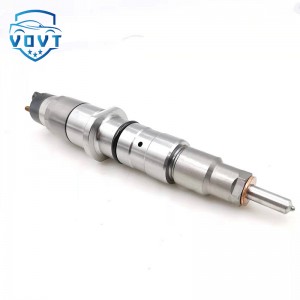
Professional Manufacture 0 445 110 520 Diesel Injector Common Rail Injector Engine Parts Vehicle Parts 0445110520


products description
| Reference. Codes | 0 445 110 520 |
| Application | / |
| MOQ | 4PCS |
| Certification | ISO9001 |
| Place of Origin | China |
| Packaging | Neutral packing |
| Quality Control | 100% tested before shipment |
| Lead time | 7~10 working days |
| Payment | T/T, L/C, Paypal, Western Union, MoneyGram or as your requirement |
Quality Stability and Error Coupling Control in Ultra-Precision Grinding of Injector Mating Components
Injector mating components, such as needle valves and nozzle bodies, operate with micron-level clearances and extremely sensitive geometric matching requirements. Ultra-precision grinding is widely used to achieve the necessary surface finish and dimensional accuracy; however, the final functional performance of injector assemblies is not determined by single-component accuracy alone. Instead, it is governed by the coupling and accumulation of grinding-induced errors throughout the manufacturing and assembly chain. As a result, quality control must focus on both error generation and error interaction mechanisms.
One significant challenge in ultra-precision grinding is the hidden transfer of geometric errors between machining stages. Small deviations in cylindricity or coaxiality introduced during early grinding operations may remain undetected in isolated inspections, yet they can significantly affect contact behavior once components are assembled. When mating surfaces interact under high injection pressure, these geometric inconsistencies lead to uneven stress distribution, micro-leakage paths, and unstable needle motion.
Surface integrity also plays a critical role in error coupling. Ultra-low roughness values are commonly targeted in injector components, but surface texture orientation and residual micro-defects can influence lubrication film formation. Grinding-induced micro-grooves or directional patterns may align unfavorably after assembly, increasing friction sensitivity and reducing repeatability in injector response. Therefore, surface quality evaluation must extend beyond average roughness parameters to include texture uniformity and directionality.
Advanced metrology techniques provide effective tools for controlling error transmission. High-resolution roundness measurement, three-dimensional surface profiling, and functional clearance mapping enable comprehensive characterization of mating components before assembly. By integrating these measurement results into a digital quality database, manufacturers can trace error sources and evaluate their potential impact on system-level performance.
In addition to measurement, process stability is essential for long-term quality consistency. Tool condition monitoring and grinding wheel dressing optimization help reduce random variation, while temperature-controlled machining environments minimize thermal drift. Furthermore, data-driven process control methods, such as trend analysis and predictive quality modeling, allow early intervention before deviations exceed acceptable limits.
In summary, ensuring quality stability in ultra-precision grinding of injector mating components requires a holistic approach that considers error coupling rather than isolated tolerances. By combining advanced metrology, stable grinding processes, and data-based quality management, the transmission of grinding-induced errors can be effectively controlled. This integrated strategy supports the production of high-precision injector assemblies with improved reliability, consistency, and service performance.
Related products
| 1 | 5WS40200 | 11 | A2C59514909/ | 21 | 31336585 |
| 2 | FA2C53252642 | 12 | A2C59511602 | 22 | 36001726 |
| 3 | 1685796 | 13 | A2C59513556 | 23 | 1709667 |
| 4 | 31303994 | 14 | 5ws40677 | 24 | 36001727 |
| 5 | 50274V05 | 15 | 50274V0 | 25 | 9445R |
| 6 | 5WS40087 | 16 | 5WS40677 | 26 | 00Q1T |
| 7 | 16600-00Q1T | 17 | AV6Q9F593-AB | 27 | 5WS40007 |
| 8 | 00Q0H | 18 | AV6Q9F593-AA | 28 | A2C59513997 |
| 9 | 5WS40148-Z | 19 | A2C59511606 | 29 | 5WS40250 |
| 10 | 2S6Q-9F593-AB | 20 | 16600-00Q0P | 30 | A2C59514912 |
Products categories
-

Professional Manufacture 0 445 110 307 Diesel I...
-

China Made Diesel Fuel Injector 0 445 120 064 F...
-

Professional Manufacture 0 445 120 250 Diesel I...
-

Professional Manufacture 0 445 110 059 Diesel I...
-
Diesel Injector Fuel Injector 0445120112 Bosch ...
-

Professional Manufacture 0 445 120 161 Diesel I...


