
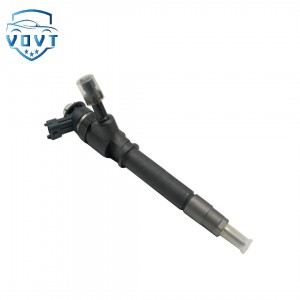
Professional Manufacture 0 445 110 435 Diesel Injector Common Rail Injector Engine Parts Vehicle Parts 0445110435


products description
| Reference. Codes | 0 445 110 435 |
| Application | / |
| MOQ | 4PCS |
| Certification | ISO9001 |
| Place of Origin | China |
| Packaging | Neutral packing |
| Quality Control | 100% tested before shipment |
| Lead time | 7~10 working days |
| Payment | T/T, L/C, Paypal, Western Union, MoneyGram or as your requirement |
Numerical Investigation of Cavitation Behavior in Fuel Injectors under Multi-Operating Conditions and Its Impact on Spray Performance
1. Introduction
With the continuous development of high-pressure fuel injection technology, injector operating pressure has exceeded 200 MPa in many modern engines. Under such extreme conditions, cavitation inside the injector becomes unavoidable. Cavitation significantly influences internal flow stability, spray formation, and injector durability. On one hand, moderate cavitation can enhance atomization; on the other hand, excessive cavitation leads to flow instability, hydraulic loss, noise, and severe erosion of critical components.
Most existing studies mainly focus on steady-state cavitation in simplified nozzle geometries. However, actual injectors operate under transient needle motion and multi-variable working conditions, and the cavitation behavior shows strong nonlinearity and unsteadiness. Therefore, it is necessary to systematically investigate cavitation evolution under different operating conditions and analyze its influence on spray performance. In this study, a transient CFD model is established to simulate cavitation inside a real injector, and the effects of injection pressure, back pressure, and nozzle geometry on cavitation are comprehensively analyzed.
2. Computational Model and Boundary Conditions
The three-dimensional internal structure of a typical high-pressure injector, including the needle valve, sac volume, and nozzle holes, is reconstructed based on engineering dimensions. A structured–unstructured hybrid mesh is generated, with strong local refinement in the orifice inlet and needle clearance regions where cavitation is most likely to occur. A mesh independence study is conducted to ensure numerical reliability.
The liquid fuel is modeled as a compressible fluid, and the Zwart–Gerber–Belamri cavitation model is used to describe the phase transformation between liquid and vapor. Large Eddy Simulation (LES) is adopted to capture transient turbulent structures more accurately. The inlet is set as a time-varying pressure boundary to represent the actual injection pressure waveform, while the outlet boundary corresponds to different back-pressure conditions simulating in-cylinder environments.
3. Cavitation Evolution under Different Operating Conditions
The numerical results reveal that cavitation inception always occurs near the inlet corner of the nozzle hole during the early stage of needle opening. With increasing injection pressure, a vapor sheet gradually develops along the nozzle wall and evolves into large-scale cloud cavitation.
Under low back-pressure conditions, cavitation expands rapidly and occupies most of the nozzle cross-section, leading to a明显 reduction in effective flow area. This causes mass flow rate saturation and induces strong outlet velocity fluctuation. In contrast, higher back pressure effectively suppresses the growth of cavitation bubbles and stabilizes the internal flow field.
The transient development of cavitation also exhibits明显 periodic shedding characteristics associated with pressure oscillation inside the sac volume. This unsteady behavior is one of the primary sources of injection noise and pressure wave propagation in the fuel system.
4. Influence of Cavitation on Spray Characteristics
To study the effect of internal cavitation on external spray behavior, the nozzle outlet velocity profile obtained from CFD is coupled with a Lagrangian spray breakup model. The spray penetration, cone angle, and droplet size distribution are quantitatively analyzed.
The results indicate that moderate cavitation increases outlet turbulence intensity and promotes primary breakup of the fuel jet, leading to smaller Sauter mean diameter (SMD) and wider spray angle. However, when cavitation becomes excessive, the unstable jet core causes large velocity fluctuations, resulting in poor spray symmetry and increased droplet dispersion irregularity.
Additionally, strong cavitation significantly increases hydraulic energy loss, reducing effective injection efficiency. Therefore, cavitation exhibits a dual effect on spray performance, and its intensity must be carefully controlled in injector design.
5. Engineering-Oriented Structural Improvement
Based on the cavitation distribution characteristics, an engineering-oriented structural improvement is proposed. The sac volume shape is locally modified to reduce vortex intensity, and the inlet contraction profile of the nozzle hole is redesigned to form a smoother pressure gradient.
After optimization, the maximum vapor volume fraction is reduced by approximately 35% under rated working conditions. The flow coefficient increases by 6–8%, and outlet velocity fluctuation amplitude decreases significantly. More importantly, the optimized injector shows improved spray symmetry and narrower droplet size distribution, indicating enhanced atomization stability.
6. Conclusions
This study numerically investigates the transient cavitation behavior inside a high-pressure fuel injector under multiple operating conditions and analyzes its coupling relationship with spray performance. The main conclusions are summarized as follows:
-
Cavitation is strongly dependent on injection pressure, back pressure, and geometric discontinuities inside the injector.
-
Moderate cavitation can enhance atomization, while excessive cavitation leads to flow choking, spray instability, and energy loss.
-
Transient cavitation exhibits periodic shedding characteristics, which is an important source of pressure fluctuation and injection noise.
-
Through targeted structural optimization of the nozzle inlet and sac volume, cavitation intensity can be effectively controlled while maintaining high injection efficiency.
The results provide valuable theoretical guidance for cavitation control and performance optimization of high-pressure injectors and are of practical significance for the development of next-generation fuel injection systems.
Related products
| 1 | 5WS40200 | 11 | A2C59514909/ | 21 | 31336585 |
| 2 | FA2C53252642 | 12 | A2C59511602 | 22 | 36001726 |
| 3 | 1685796 | 13 | A2C59513556 | 23 | 1709667 |
| 4 | 31303994 | 14 | 5ws40677 | 24 | 36001727 |
| 5 | 50274V05 | 15 | 50274V0 | 25 | 9445R |
| 6 | 5WS40087 | 16 | 5WS40677 | 26 | 00Q1T |
| 7 | 16600-00Q1T | 17 | AV6Q9F593-AB | 27 | 5WS40007 |
| 8 | 00Q0H | 18 | AV6Q9F593-AA | 28 | A2C59513997 |
| 9 | 5WS40148-Z | 19 | A2C59511606 | 29 | 5WS40250 |
| 10 | 2S6Q-9F593-AB | 20 | 16600-00Q0P | 30 | A2C59514912 |
Products categories
-

High Quality Diesel Fuel Injector 0 445 120 219...
-
High Quality Diesel injector 0 445 115 060 0445...
-

Made in China New Diesel Fuel Injector 0 445 11...
-

Professional Manufacture 0 432 191 259 Diesel I...
-

High Quality Diesel Injector 0445120057 0 445 1...
-
Best-Selling Good Quality 0 445 110 699 Diesel ...


