
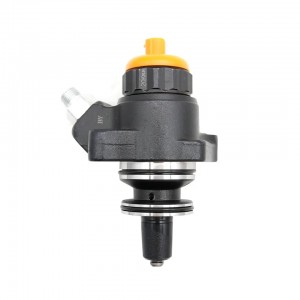
New Pressure Regulator Suction Pressure Valve Control Valve 0 281 006 037 0281006037 for Auto Spare Parts


Products Description
| Reference Codes | 0 281 006 037 |
| Application | / |
| MOQ | 12PCS |
| Certification | ISO9001 |
| Place of Origin | China |
| Packaging | Neutral packing |
| Quality Control | 100% tested before shipment |
| Lead time | 7~10 working days |
| Payment | T/T, L/C, Paypal, Western Union, MoneyGram or as your requirement |
Self-Adaptive Dynamic Control Strategy for Smart Pressure Relief Valves Using Fuzzy Logic
In modern hydraulic and fuel supply systems, pressure relief valves must operate reliably under highly variable load and flow conditions. Conventional valves with fixed opening characteristics often struggle to balance pressure stability and energy efficiency when system parameters change. To overcome these limitations, this study presents a self-adaptive dynamic control strategy for smart pressure relief valves based on fuzzy logic.
Unlike traditional control approaches that rely on predefined thresholds, the proposed strategy introduces an adaptive fuzzy control framework that continuously adjusts valve response according to real-time system behavior. Pressure fluctuation amplitude and valve response delay are selected as key control inputs, reflecting both system stability and dynamic performance. The control output modulates the valve actuation level, enabling smooth and continuous pressure regulation.
A coupled electro-hydraulic model of the smart pressure relief valve is developed to analyze system dynamics under variable operating conditions. The fuzzy controller is embedded within the valve control unit, allowing on-line adjustment of control actions without explicit parameter identification. This feature is particularly advantageous in systems where fluid properties, such as viscosity and temperature, vary significantly during operation.
Simulation results show that the self-adaptive fuzzy control strategy effectively suppresses pressure spikes during rapid flow transients and load disturbances. Compared with conventional proportional control, the proposed method reduces peak pressure by up to 30% and improves settling speed. Furthermore, the valve exhibits enhanced stability when subjected to repeated high-frequency pressure fluctuations, indicating improved fatigue resistance for downstream components.
From an implementation perspective, the control strategy is designed with low computational complexity, making it suitable for real-time execution on embedded controllers. The integration of standard pressure sensors and compact actuators enables easy deployment without major system redesign. In addition, the adaptive nature of the fuzzy logic controller reduces the need for manual tuning during commissioning and maintenance.
The study also evaluates energy efficiency improvements achieved by the smart valve. By avoiding excessive pressure release and maintaining optimal pressure levels, the system experiences reduced hydraulic losses and lower heat generation. This contributes to improved overall system efficiency and extended component service life.
In conclusion, the proposed self-adaptive fuzzy logic control strategy enhances the dynamic performance and robustness of smart pressure relief valves. Its adaptability, simplicity, and engineering feasibility make it a promising solution for next-generation pressure control systems in hydraulic and fuel applications.
Products categories
-

High Quality Diesel injection pump Plunger 2425...
-

Made in China Fuel Injection Pump Plunger 1701 ...
-
Common Rail Injection Pump Plunger 094150-0330 ...
-

Diesel Fuel Injection Pump 319-0675 Engine Auto...
-

High Quality New Diesel Fuel Injection Pump 046...
-

High Quality New Diesel Fuel Common Rail Inject...


