
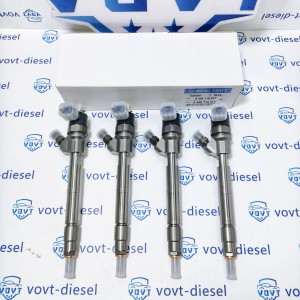
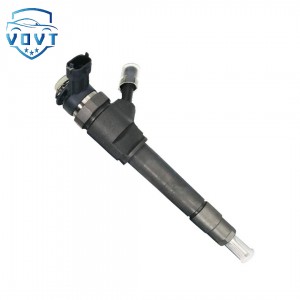
Professional Manufacture 0 445 110 738 Diesel Injector Common Rail Injector Engine Parts Vehicle Parts 0445110738


products description
| Reference. Codes | 0 445 110 738 |
| Application | / |
| MOQ | 4PCS |
| Certification | ISO9001 |
| Place of Origin | China |
| Packaging | Neutral packing |
| Quality Control | 100% tested before shipment |
| Lead time | 7~10 working days |
| Payment | T/T, L/C, Paypal, Western Union, MoneyGram or as your requirement |
Error Propagation Mechanisms and Quality Control in Ultra-Precision Grinding of Injector Precision Pairs
Precision pairs used in fuel injectors, such as needle–nozzle and plunger–barrel assemblies, require extremely tight dimensional tolerances and surface integrity to ensure accurate fuel metering and reliable sealing performance. Ultra-precision grinding is a key finishing process for these components, yet even minor process-induced errors can propagate through subsequent assembly stages, significantly affecting injector performance. Therefore, understanding error transmission mechanisms and establishing effective quality control strategies are critical in precision pair manufacturing.
During ultra-precision grinding, multiple error sources coexist, including machine tool geometric inaccuracies, spindle vibration, thermal deformation, and wheel wear. These errors are not isolated; instead, they interact and accumulate along the grinding path. For example, spindle runout directly influences roundness deviation, while thermal drift alters dimensional consistency over batch production. Once introduced, such errors are difficult to eliminate in later processes and may amplify during component pairing.
One major error transmission pathway occurs through surface waviness and form deviation. In precision injector components, slight taper or out-of-roundness generated during grinding leads to non-uniform contact pressure after assembly. This uneven contact accelerates localized wear and increases internal leakage under high-pressure operation. Furthermore, surface roughness variations affect the formation of lubrication films, indirectly influencing friction behavior and dynamic response of the injector.
To control error propagation, in-process monitoring has become an essential quality assurance approach. Real-time measurement of grinding forces, vibration signals, and temperature variation allows early detection of abnormal process states. By correlating these signals with dimensional inspection results, critical process parameters can be dynamically adjusted to prevent error accumulation. Additionally, adaptive compensation techniques based on feedback control help correct systematic errors caused by tool wear or thermal expansion.
Statistical quality control also plays an important role in managing batch consistency. By analyzing dimensional distributions and surface integrity metrics, process capability indices can be established for key grinding parameters. This approach enables manufacturers to identify dominant error contributors and optimize process windows accordingly. Moreover, pairing strategies based on selective assembly can further reduce the impact of residual errors by matching components with complementary deviation characteristics.
In conclusion, error propagation in ultra-precision grinding of injector precision pairs is a multi-factor and multi-stage process. Effective quality control requires an integrated strategy combining process monitoring, adaptive compensation, and statistical analysis. By minimizing error transmission at the grinding stage, manufacturers can significantly enhance injector reliability, consistency, and service life, meeting the increasingly stringent performance requirements of modern fuel injection systems.
Related products
| 1 | 5WS40200 | 11 | A2C59514909/ | 21 | 31336585 |
| 2 | FA2C53252642 | 12 | A2C59511602 | 22 | 36001726 |
| 3 | 1685796 | 13 | A2C59513556 | 23 | 1709667 |
| 4 | 31303994 | 14 | 5ws40677 | 24 | 36001727 |
| 5 | 50274V05 | 15 | 50274V0 | 25 | 9445R |
| 6 | 5WS40087 | 16 | 5WS40677 | 26 | 00Q1T |
| 7 | 16600-00Q1T | 17 | AV6Q9F593-AB | 27 | 5WS40007 |
| 8 | 00Q0H | 18 | AV6Q9F593-AA | 28 | A2C59513997 |
| 9 | 5WS40148-Z | 19 | A2C59511606 | 29 | 5WS40250 |
| 10 | 2S6Q-9F593-AB | 20 | 16600-00Q0P | 30 | A2C59514912 |
Products categories
-

Professional Manufacture 0 445 120 007 Diesel I...
-

Factory Price New Diesel Fuel Injector 04321911...
-

Professional Manufacture 0 432 193 532 Diesel ...
-

Professional Manufacture 0 445 120 161 Diesel I...
-
Professional Manufacture 0 445 110 317 Diesel I...
-
New High Quality Diesel Injector 0 445 110 139 ...


