
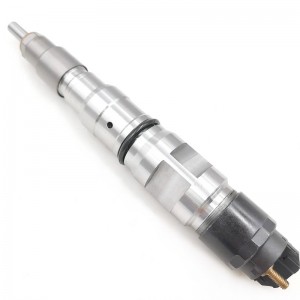
Professional Manufacture 0 432 131 667 Diesel Injector Common Rail Injector Engine Parts Vehicle Parts 0432131667


products description
| Reference. Codes | 0 432 131 667 |
| Application | / |
| MOQ | 4PCS |
| Certification | ISO9001 |
| Place of Origin | China |
| Packaging | Neutral packing |
| Quality Control | 100% tested before shipment |
| Lead time | 7~10 working days |
| Payment | T/T, L/C, Paypal, Western Union, MoneyGram or as your requirement |
Effect of Internal Pressure Wave Reflection on Injection Stability in High-Pressure Fuel Injectors
In high-pressure fuel injection systems, pressure waves generated during rapid valve opening and closing propagate through the injector’s internal passages. These transient pressure waves interact with internal cavities and geometric discontinuities, producing reflection and superposition phenomena that directly influence injection stability. Despite their importance, internal pressure wave dynamics are often overlooked in injector performance analysis.
When the injector needle lifts abruptly, a high-intensity pressure wave is generated at the nozzle inlet. This wave travels upstream through the internal fuel passages and encounters changes in cross-sectional area, such as control chambers, damping volumes, and valve seats. At these locations, partial reflection and transmission occur, forming complex pressure oscillations within the injector body.
The reflected pressure waves may either reinforce or counteract the pressure driving the needle motion, depending on their phase relationship. If constructive interference occurs, localized pressure peaks can accelerate needle movement, leading to excessive injection rate rise. Conversely, destructive interference may suppress needle lift or cause premature closure, resulting in reduced or unstable injection quantities.
Internal cavity geometry plays a key role in determining pressure wave behavior. Larger cavity volumes tend to attenuate pressure fluctuations but may increase response delay, while smaller cavities amplify pressure oscillations. Sharp corners and abrupt area changes intensify wave reflection, whereas smoothly contoured transitions help dissipate pressure energy.
Experimental studies using high-frequency pressure sensors embedded in injector bodies reveal that pressure oscillation amplitude increases with rail pressure and injection speed. These oscillations become particularly significant during short-duration injections, such as pilot injections, where pressure wave effects represent a large fraction of the total injection event.
Numerical simulations based on one-dimensional unsteady flow models and acoustic wave theory are commonly employed to analyze pressure wave propagation. By coupling these models with needle dynamics, the interaction between pressure waves and mechanical motion can be predicted with good accuracy.
To improve injection stability, design optimization focuses on pressure wave management rather than suppression alone. Strategies include optimizing internal cavity lengths to shift resonance frequencies, smoothing flow transitions, and incorporating damping volumes to reduce wave reflection intensity.
In summary, internal pressure wave reflection is a critical factor affecting injector injection stability, especially under high-pressure and high-speed conditions. Understanding and controlling these wave phenomena provides a new pathway for improving injector precision and reliability in advanced fuel injection systems.
Related products
| 1 | 5WS40200 | 11 | A2C59514909/ | 21 | 31336585 |
| 2 | FA2C53252642 | 12 | A2C59511602 | 22 | 36001726 |
| 3 | 1685796 | 13 | A2C59513556 | 23 | 1709667 |
| 4 | 31303994 | 14 | 5ws40677 | 24 | 36001727 |
| 5 | 50274V05 | 15 | 50274V0 | 25 | 9445R |
| 6 | 5WS40087 | 16 | 5WS40677 | 26 | 00Q1T |
| 7 | 16600-00Q1T | 17 | AV6Q9F593-AB | 27 | 5WS40007 |
| 8 | 00Q0H | 18 | AV6Q9F593-AA | 28 | A2C59513997 |
| 9 | 5WS40148-Z | 19 | A2C59511606 | 29 | 5WS40250 |
| 10 | 2S6Q-9F593-AB | 20 | 16600-00Q0P | 30 | A2C59514912 |
Products categories
-

High Quality Common Rail Diesel Fuel Injector 0...
-
28229873 CRDI Fuel Diesel Injector 33800 4A710 ...
-

Cost-Effective New Fuel Injector 0 445 111 091 ...
-

Professional Manufacture 0 445 120 369 Diesel I...
-
Diesel Injector Fuel Injector 0 445 110 189 0 4...
-

Professional Manufacture 0 445 120 398 Diesel I...


