
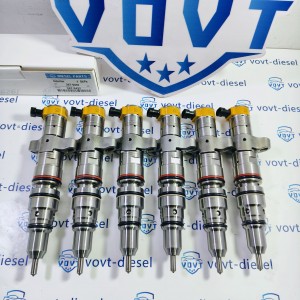
New High Quality Made in China Diesel Injector 2645A753 For CAT


Products Description
| Reference. Codes | 2645A753 |
| Application | 7W7026 |
| MOQ | 4PCS |
| Certification | ISO9001 |
| Place of Origin | China |
| Packaging | Neutral packing |
| Quality Control | 100% tested before shipment |
| Lead time | 7~10 working days |
| Payment | T/T, L/C, Paypal, Western Union, MoneyGram or as your requirement |
Throttling Structure and Flow Control Mechanism in Diesel Fuel Injectors
In modern diesel fuel injectors, precise control of fuel flow is achieved not only through pressure regulation but also through carefully designed internal throttling structures. These small flow restrictions play a critical role in managing pressure distribution, response speed, and injection stability.
Inside the injector, fuel flows through multiple passages before reaching the nozzle. Along these paths, calibrated orifices and narrow channels act as throttling elements. These restrictions control the rate of fuel flow between different chambers, especially the control chamber that governs needle movement.
When the injector receives a control signal, pressure in the control chamber is adjusted by allowing fuel to flow through a throttling path. The rate at which pressure decreases determines how quickly the needle lifts. A well-designed throttling structure ensures a rapid yet stable pressure drop, enabling precise injection timing.
During the closing phase, throttling also influences how quickly pressure recovers in the control chamber. If pressure recovery is too slow, the needle may remain open longer than intended, affecting injection accuracy. Therefore, the balance between inflow and outflow restrictions is essential.
Throttling structures also contribute to damping pressure fluctuations. By limiting rapid flow changes, they help smooth pressure transitions within the injector. This reduces the risk of oscillations that could lead to unstable needle motion or inconsistent fuel delivery.
The size, shape, and surface quality of throttling passages directly affect flow characteristics. Even microscopic variations in diameter can significantly change flow resistance. For this reason, high-precision manufacturing techniques are required to maintain consistency across injectors.
Fuel properties such as viscosity and temperature influence throttling behavior as well. Changes in these properties alter flow resistance, requiring injector designs that can maintain stable performance under varying conditions.
In summary, internal throttling structures are essential for controlling fuel flow and pressure dynamics within diesel injectors. Their precise design ensures accurate needle movement, stable injection timing, and consistent engine performance.
Products categories
-

New High Quality Diesel Injector 253-0618 10R-2...
-

Construction Machinery Engine Parts Fuel Common...
-
New High Quality Diesel Injector 387-9432 38794...
-

New High Quality Diesel Injector 239-4907 10R-1...
-

High Quality New Diesel Injector CAT C9 Common ...
-

Auto Parts Fuel Injector Diesel Injection 178-0...


