
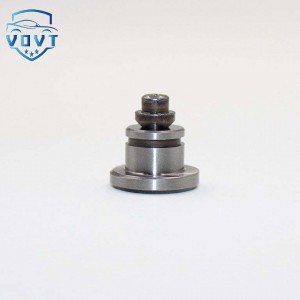
High Quality Delivery Valve F832 Diesel Engine Spare Parts


Products Description
| Reference Codes | F832 |
| Application | / |
| MOQ | 12 PCS |
| Certification | ISO9001 |
| Place of Origin | China |
| Packaging | Neutral packing |
| Quality Control | 100% tested before shipment |
| Lead time | 7~15 working days |
| Payment | T/T, L/C, Paypal, Western Union, MoneyGram or as your requirement |
Suppression Effect of Delivery Valves on Pressure Oscillation in High-Pressure Fuel Pumps
During the operation of high-pressure fuel pumps, pressure oscillations inevitably occur due to the periodic reciprocating motion of the plunger, fuel compressibility, and the elastic characteristics of high-pressure pipelines. Excessive pressure oscillations can lead to increased noise and vibration, reduced fuel metering accuracy, unstable injection behavior, and accelerated fatigue damage of key components. Therefore, investigating effective methods to suppress pressure oscillations is of great importance for improving the performance and reliability of high-pressure fuel injection systems. Among various influencing factors, the delivery valve plays a critical role in controlling and mitigating pressure fluctuations.
The delivery valve is a key functional component in high-pressure fuel pumps, primarily responsible for allowing fuel delivery to the high-pressure line during the plunger’s delivery stroke and preventing reverse flow during the return stroke. This unidirectional flow control function is essential for maintaining pressure stability in the fuel system. When the plunger completes the delivery phase and starts its return motion, the rapid closure of the delivery valve isolates the pump chamber from the high-pressure pipeline. This isolation effectively limits pressure backflow and weakens the propagation and reflection of pressure waves within the system, thereby reducing pressure oscillation amplitude.
The dynamic behavior of the delivery valve has a direct influence on its pressure suppression capability. Structural parameters such as valve mass, spring stiffness, preload force, and valve seat geometry significantly affect the opening and closing characteristics of the valve. For instance, increasing spring stiffness and preload force can accelerate valve closure, minimizing reverse flow and reducing low-frequency pressure fluctuations. However, excessive stiffness may induce valve impact, secondary oscillations, or increased mechanical stress, which can negatively affect system stability. Consequently, the design of delivery valves requires a careful balance between fast dynamic response and smooth closing behavior.
In practical applications, pressure-reducing or damping-type delivery valves are widely adopted in modern high-pressure fuel pumps. These valves incorporate throttling passages, damping chambers, or stepped valve structures to slow down the closing process and absorb pressure energy. By converting part of the pressure energy into flow resistance losses, such designs effectively suppress high-frequency pressure oscillations and reduce pressure wave reflection in the high-pressure line. As a result, the stability of downstream fuel injection processes is significantly improved.
Furthermore, the delivery valve influences the transmission characteristics of pressure waves within the fuel system. By altering wave reflection conditions at the pump outlet, the delivery valve can reduce interference between successive injection cycles, contributing to more consistent injection pressure and improved combustion performance. This effect is particularly important in high-speed and ultra-high-pressure fuel injection systems, where pressure fluctuations tend to be more severe.
In summary, the delivery valve serves not only as a unidirectional flow control element but also as a crucial component for suppressing pressure oscillations in high-pressure fuel pumps. Through optimized structural design and dynamic parameter matching, delivery valves can significantly enhance pressure stability, reduce noise and vibration, and improve the overall reliability of fuel injection systems. These findings provide valuable theoretical guidance and practical reference for the development of high-precision, low-noise, and high-durability fuel pump systems.
Products categories
-
High Quality New Diesel Fuel Injection Pump Del...
-

High Quality Delivery Valve F210 Diesel Engine ...
-

High Quality Delivery Valve FZ5BQ Diesel Engine...
-

Original Quality VE Type Delivery Valve 096420-...
-

High Quality Delivery Valve 161S2 Diesel Engine...
-

High Quality Delivery Valve VE4 Diesel Engine S...


