
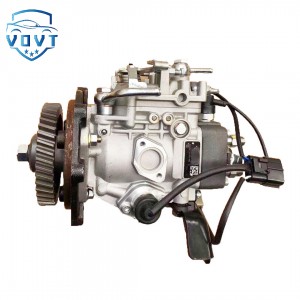
Diesel Fuel Injection Pump 101402-9632 Engine Auto Engine Part


products description
| Reference Code | 101402-9632 |
| MOQ | 1 PCS |
| Certification | ISO9001 |
| Place of Origin | China |
| Packaging | Neutral packing |
| Quality Control | 100% tested before shipment |
| Lead time | 7~15 working days |
| Payment | T/T, Western Union, Money Gram, Paypal, Alipay, Wechat |
Performance Optimization of High-Pressure Fuel Pumps Through Advanced Flow Control Strategies
High-pressure fuel pumps play a critical role in modern internal combustion engines by maintaining stable fuel delivery to the injection system under varying operating conditions. As engine efficiency and emission standards continue to rise, the requirements for pump response speed, volumetric efficiency, and pressure stability have also become more demanding. This study focuses on advanced flow control strategies that can improve fuel pump performance without significant structural redesign.
One of the core challenges in high-pressure pump operation is managing flow pulsation caused by the reciprocating motion of the plunger. Flow pulsation not only affects injection precision but also contributes to pressure oscillations within the rail, negatively impacting combustion stability. To address this issue, a variable-inlet control strategy is introduced, which adjusts inlet port timing based on real-time pump rotational speed and fuel demand. Simulation results show that this strategy reduces flow pulsation amplitude by more than 20% under medium- to high-load conditions.
Another optimization approach involves the use of smart control valves equipped with fast-response solenoids. By precisely regulating the opening duration of the inlet metering valve, the pump can maintain a more linear relationship between commanded and delivered fuel quantity. Experimental validation demonstrates improved pressure trace smoothness and up to 5% reduction in power consumption due to decreased hydraulic losses.
Thermal management also plays a key role in pump performance. High-temperature operation can lead to rapid wear of the plunger–barrel pair, reducing efficiency and increasing leakage. To mitigate this effect, the study evaluates the implementation of micro-channel cooling integrated into the pump housing. Enhanced thermal dissipation results in a 12°C reduction in steady-state operating temperature, significantly improving component durability.
Finally, the paper explores the potential of adaptive algorithms that use machine learning to predict fuel demand and adjust pump control parameters dynamically. Early testing indicates promising improvements in transient response, especially during rapid load shifts.
Overall, the combination of variable inlet timing, intelligent valve actuation, enhanced heat dissipation, and adaptive control algorithms provides a comprehensive strategy for improving high-pressure fuel pump performance while maintaining system reliability.
Products categories
-
Diesel Injection VE Fuel Pump 104641-5680 Diese...
-

Diesel Fuel Injection Pump 476-8769 For CAT Eng...
-

High Quality New Diesel Fuel Injection Pump 046...
-

Diesel fuel injection VE pump VE4 11F1800LLD17 ...
-

High Quality New Fuel Injection Pump BH4AD95R D...
-

Diesel Fuel Injection Pump 319-0676 Engine Auto...


