
Artificial intelligence is transforming vehicle repair, improving the accuracy of vehicle troubleshooting and enabling smarter diagnostics. We look at some key innovations and analyze the addressable market for repair globally.
he automotive aftermarket is no stranger to artificial intelligence (AI) in cars. Messaging apps that schedule vehicle repair appointments in minutes, software that automatically sends maintenance interval reminders and algorithms that help with inventory management and remote vehicle diagnostic tools have been around for a while. These are examples of AI working quietly in the background.
But as vehicles become more complex and AI technology progresses, AI adoption is becoming more prevalent, especially in vehicle repair. Predictive maintenance, diagnostics, customer service, vehicle inspections and damage assessment are increasingly using AI. In predictive maintenance, for instance, AI is used to analyze the rising quantities of vehicle data to identify patterns and make vehicle repair services predictions.
Technology firms expand their role in AI-driven vehicle repair
As the vehicle repair and service industry embraces artificial intelligence in cars, technology firms and leading automotive suppliers are launching products and pursuing strategic acquisitions to strengthen their position in this rapidly evolving space.
In March 2026, Bosch announced plans to acquire Uptake Technologies, Inc., a Chicago-based startup specializing in AI-based predictive analytics for commercial fleets. Bosch said Uptake’s AI capabilities would expand its predictive maintenance offerings and vehicle health services capabilities.
Technology firms such as Uptake are leveraging AI to improve vehicle repair and maintenance in several ways. When a vehicle is already in the shop for routine maintenance, AI identifies minor, non-urgent repairs that can be addressed at the same time. This allows owners to get more out of scheduled vehicle repair services. AI is also used to enhance data quality by helping standardize fleet maintenance records, which often contain errors, missing details or inconsistent formatting. The cleaned data can be used for predictive modeling and trend analysis.
AI is also used to provide solutions that move from a fault code to vehicle repair, resulting in quicker, more accurate outcomes. “One fleet I reviewed recently had nearly 8,000 faults per vehicle annually, which makes it difficult to distinguish critical issues from noise,” stated Brian Silva, senior director of data science at Uptake. By applying AI, he said, the company can “reduce those 8,000 codes to just 5–10 actionable issues per vehicle each year.”
At the AAPEX Show in November 2025, Bosch demonstrated its AI-powered diagnostic assistant called the Super Technician. It uses Bosch’s global knowledge pool of vehicle repair issues and solutions to help technicians diagnose problems.
Swedish parts distributor Meko has rolled out a similar service. In March 2026, the company announced an AI service for faster and more accurate vehicle diagnostics. The service uses a database to provide technicians with the information needed to carry out vehicle repairs. The growing database includes information on the repairs handled by Meko’s workshop chains over the past decade.
Bilstein’s aftermarket brand Febi has launched a fluid testing device for garages that can assess fluid condition and contaminants on site. The AI-enabled vehicle diagnostic tool analyzes samples of fluids like engine oil or transmission fluid and generates a report detailing their condition and the likely causes of any abnormalities. The company says this process enhances transparency with the customer and opens new revenue opportunities.
In March 2026, AutoTechIQ, a digital vehicle assessment service in the US, introduced AutoQuoteIQ, a platform for workshops to streamline estimates. The platform uses AI, the shop’s historical data and millions of work orders to help generate accurate and transparent vehicle repair estimates.
Global vehicle repair services expand as out-of-warranty fleet grows
S&P Global Mobility expects about 426 million vehicles in operation (VIO) to be out-of-warranty in Europe by the end of 2035, the highest of any region globally. This data provides an indication of the vast pool of vehicles the aftermarket will have to support with parts, service and repairs.
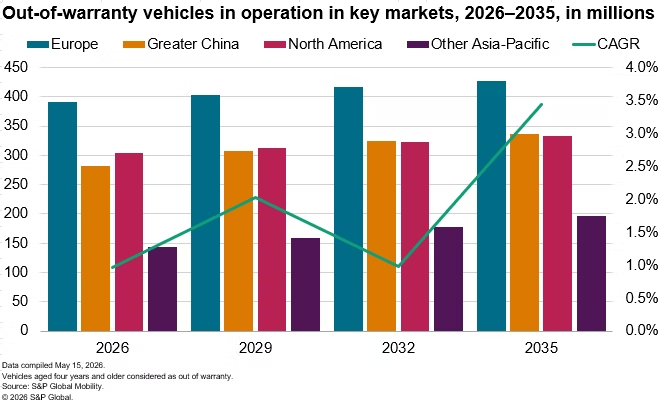
Out-of-warranty vehicles in operation in key markets
Greater China is forecast to have the second-largest pool of out-of-warranty VIO—337 million by 2035. The region’s out-of-warranty car parc is expected to grow at a healthy compound annual growth rate (CAGR) of 2% from 2026 to 2035, overtaking North America (CAGR: 1%) in overall volumes by the end of the decade.
The highest growth in out-of-warranty VIO among key global regions is expected in Other Asia Pacific (CAGR: 3.4%). This represents roughly 3.5x faster growth than in Europe or North America, albeit on a lower
Post time: Sep-04-2026


