

API Service Category CL-4 and API FB-4 ‘Donut’ certification marks enable oil marketers to align with 2027 heavy-duty engine standards.
The American Petroleum Institute approved its Proposed Category 12 (PC-12) heavy-duty engine oil specification, clearing the way for new service categories and licensing activity ahead of the 2027 model year.
The new specification will be incorporated into API 1509, the Engine Oil Licensing and Certification System (EOLCS) document.
CL-4 and FB-4 Certification Marks Released
With the approval, API Service Category CL-4 and API FB-4 “Donut” certification marks are now available.
According to API, oil marketers can begin finalizing formulations and preparing product packaging to meet the new requirements before the first licensing date of Jan. 1, 2027.
“To support the next generation of heavy-duty engine technology and emissions standards, PC-12 establishes a strong technical foundation for performance, durability, and environmental protection,” said Bill O’Ryan, director of EOLCS/DEF at API. “Making the CL-4 and FB-4 service symbols available now allows oil marketers to prepare for a smooth transition as we approach the 2027 model year.”
Licensing Timeline and Industry Preparation
API said its licensee portal will open June 1, 2026. API said this allows companies to begin entering CL-4 and FB-4 products into the system.
The early access period is intended to support industry readiness ahead of the 2027 licensing start date.
PC-12 two new categories
Work is already underway on the development of PC-12, which is expected to bring two new categories that align with the viscosity divide that exists today with API CK-4 and FA-4. The first, API ‘C’ category (PC-12A), is likely to retain the existing high temperature high shear (HTHS) viscosity minimums and to be backward compatible to older categories. The second, lower HTHS viscosity API ‘F’ category (PC-12B), is likely to extend down to 2.6 cP HTHS to enable the use of SAE XW-20 viscosity grades for further fuel economy improvement. It is targeted for use in modern and future engines and will not be backward compatible by API to older categories.
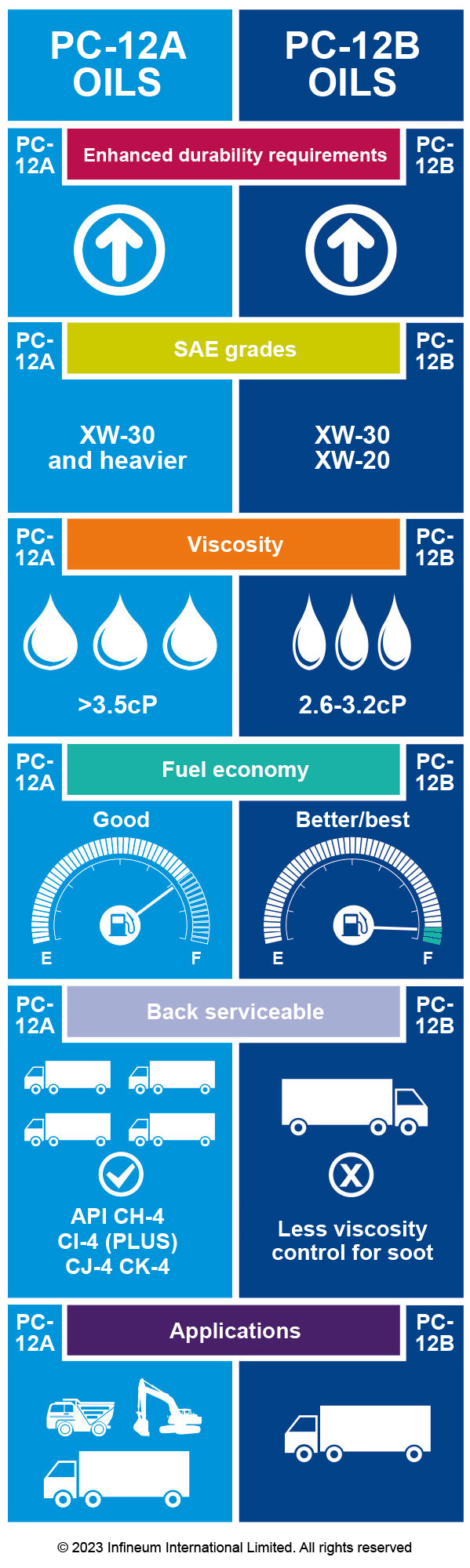
Performance Targets for Next-Generation Engines
According to API, the PC-12 specification is designed to support next-generation heavy-duty engine requirements, including:
- Improved oxidation resistance
- Enhanced wear protection
- Expanded elastomer compatibility
- Improved aftertreatment system protection
- Support for lower viscosity grades to improve fuel economy
-
PC-12 progress
Progress is underway on the development of new and replacement tests for the new categories.
Wear protection: Two wear tests are being proposed for addition to PC-12. First, the Ford 6.7L Valvetrain Wear Test, was introduced by Ford for the Ford WSS M2C171-F1 specification to help ensure engine oils protect the valvetrain of their 6.7L engine platform. This engine test development is currently working on ensuring a long-term reliable supply of engine test parts by converting to the most recent MY 2023 6.7L engine platform. Also, the Detroit Diesel DD13 Scuffing Test, was developed during the PC-11 timeframe to address concerns around scuffing in the power cylinder with lower viscosity fluids. Although not included in PC-11, it was added to Daimler Truck and Detroit Diesel specifications.
Oxidation resistance: Improved oxidation protection is needed as engines run hotter and OEMs look to retain the oil drain intervals they are accustomed to under PC-11 in these harsher conditions. This means tighter limits in the Volvo T-13 test.
Aftertreatment protection: Tighter chemical limits can also be expected to help reduce aftertreatment system poisoning. Current targets of 0.10% max phosphorus (P), 0.35% max sulphur (S), and 0.9% max sulphated ash (SASH) have been asked for by EMA as a compromise position between the varying needs of OEM members. Some OEMs have suggested that their own OEM specification chemical limits will be even tighter at levels of 0.08% max P, 0.3% max S and 0.8-0.9% SASH and possibly include new limits for potassium and sodium.
A member of EMA has also asked for the addition of a phosphorus retention parameter to be considered, based on concerns about the reduction of durability protection from the reduced amount of phosphorus in the oil and the potential for aftertreatment poisoning from certain types of phosphorus components.
Seals Protection: Protection for hydrogenated nitrile seals has been requested to be added as an additional material to be aligned with the seals materials that are currently used in the ACEA specifications.
Replacement tests: The Mack T-11 soot-induced viscosity increase control test will be replaced by a Cummins soot viscosity control test, which is expected to directly replace the Mack T-11 with similar viscosity control parameters for the new higher viscosity grade API ‘C’ category. This test development is expected to be used to fill multiple voids formed by the Mack T-11 and Mack T-8, which are approaching their end-of-life. This test development will:
- Directly replace the Mack T-11 with with equivalent soot control performance up to 6.7% soot in the new and current in API ‘C’ categories for backwards compatibility.
- Protect engines from soot viscosity growth at around 4% soot for the new lower viscosity API ‘F’ category due to the lower soot levels of modern diesel engines.
- Likely be used to replace the Mack T-8 in older API categories (API CH-4 and CI-4).
The following PC-11 tests will not be included for PC-12:
- Roller-follower wear test (RFWT) is removed as redundant with Cummins ISB test.
- Single cylinder Caterpillar 1N test is removed as redundant with multicylinder Caterpillar C13 test.
- Mack T-12 test is removed as the oxidation performance is already covered by the Volvo T-13 test and the cylinder liner wear parameter was found to correlate with Cummins ISB camshaft wear.
Post time: Apr-14-2026


